Learn Drawing: Beginner Timeline & Tips
Discover how long it takes to learn drawing with a realistic beginner timeline. Get daily practice tips and strategies to improve your sketching skills faster. Start your artistic journey today!
Black Heart
5/14/20265 min read
How Long Does It Take to Learn Drawing? (Real Beginner Timeline)
Introduction, The Question Every Beginner Asks
One of the first questions almost every beginner asks is, “How long does it take to get good at drawing?” It’s a completely normal question. When you see experienced artists creating amazing sketches, it can feel impossible to imagine yourself reaching that level.
The internet makes this even more confusing. Some people say you can learn drawing in 30 days, while others claim it takes years. The truth is somewhere in the middle.
Learning to draw is not about becoming perfect overnight. It’s a gradual process where small improvements build over time. If you practice consistently and focus on the right fundamentals, you can see real progress much faster than you think.
In this guide, you’ll learn how long it realistically takes to improve at drawing, what progress looks like month by month, and how beginners can improve faster without feeling overwhelmed.
Can Anyone Learn Drawing?
Yes, absolutely.
Drawing is a skill, not a magical talent people are born with. Some people may learn faster because they practiced earlier in life, but every skilled artist started as a beginner who struggled with lines, shapes, and proportions.
Most beginners quit too early because they compare themselves to experienced artists. What they don’t see is the thousands of hours of practice behind those drawings.
If you practice regularly and stay patient, you can absolutely learn to draw, even if you think you have zero talent right now.
How Long Does It Take to Learn Drawing, The Honest Answer
The honest answer is this, it depends on how consistently you practice and what you practice.
If you draw casually once every few weeks, progress will be slow. But if you practice regularly and focus on fundamentals, you can improve surprisingly fast.
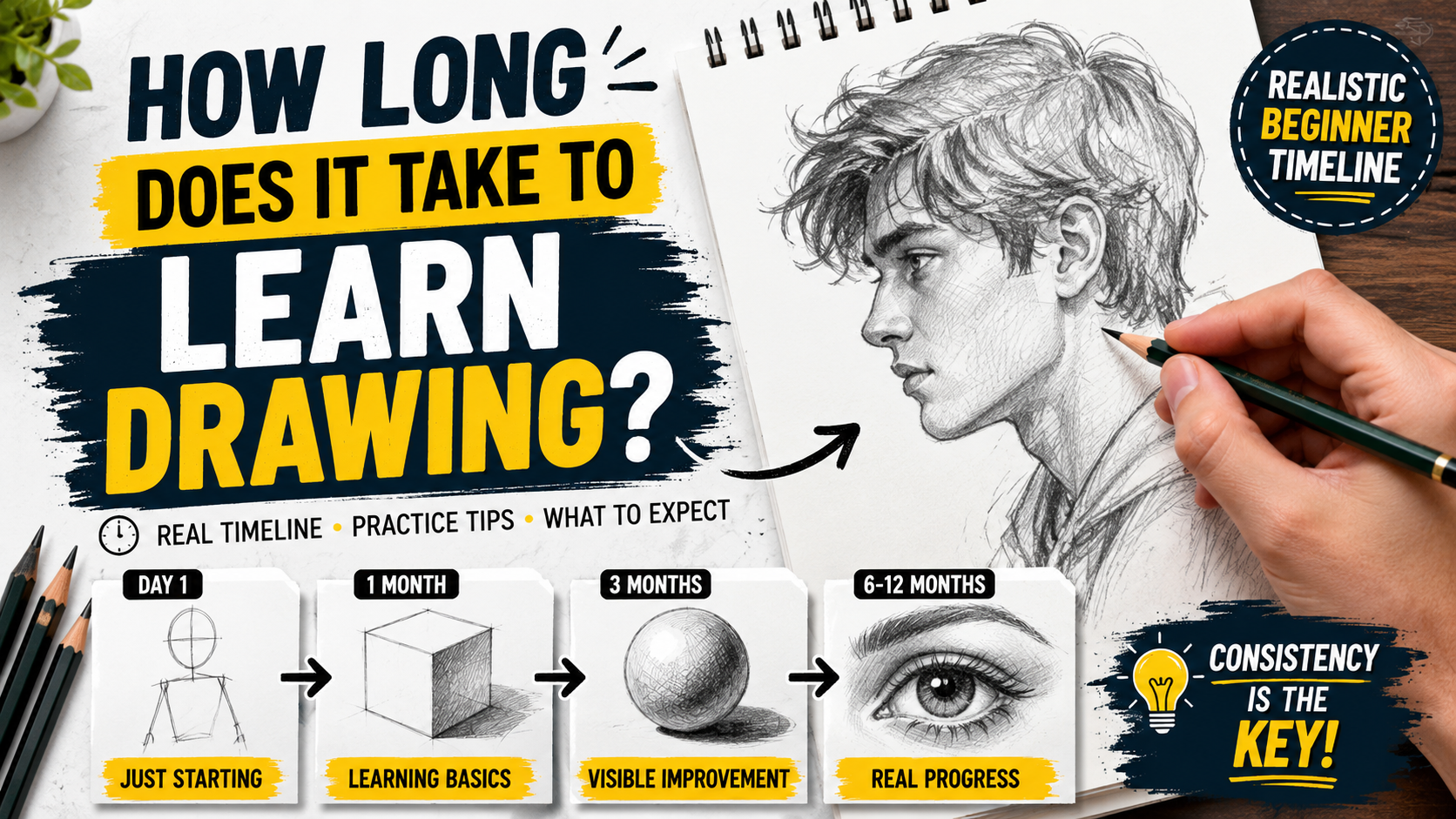
Most beginners notice visible improvement within the first 30 days. After around three months of consistent practice, you’ll start understanding shapes, proportions, and shading much better. Within six months to a year, many beginners develop strong foundational skills.
The key word here is consistency.
Drawing for 20 to 30 minutes every day is usually far more effective than practicing for five hours once a week.
What Progress Looks Like in the First 30 Days
The first month is all about building your foundation. You won’t suddenly become an amazing artist, but you will notice important improvements.
In the beginning, your lines may feel shaky and your drawings may look flat or uneven. This is completely normal. During this stage, your brain is learning hand control and observation skills.
By the end of the first month, most beginners:
Draw cleaner lines
Understand basic shapes better
Feel more comfortable holding the pencil
Start noticing proportions more accurately
Gain confidence in sketching simple objects
This stage is important because you’re developing the core skills that every artist relies on.
The 3-Month Stage, Where Real Improvement Begins
After about three months of regular practice, things start becoming much more exciting. This is usually the stage where beginners realize they are genuinely improving.
Your hand becomes more controlled, and your understanding of structure improves significantly. You begin seeing objects as combinations of shapes rather than complicated forms.
At this point, many beginners can:
Sketch simple objects confidently
Understand light and shadow
Create basic realistic shading
Draw cleaner proportions
Finish complete beginner-level sketches
This is also the stage where many people become motivated because they can finally see visible progress compared to their old drawings.
The 6-Month to 1-Year Stage, Building Real Skills
If you continue practicing consistently for six months to a year, your drawing ability can improve dramatically.
By this stage, most dedicated beginners:
Understand anatomy basics
Use shading more naturally
Draw from references more accurately
Develop better observation skills
Create detailed sketches with confidence
This is when drawing starts feeling less frustrating and more enjoyable. You spend less time struggling with basics and more time expressing ideas creatively.
However, it’s important to understand that learning art never truly ends. Even professional artists continue learning and improving throughout their careers.
Why Some Beginners Improve Faster Than Others
Not everyone improves at the same speed, and that’s okay.
Several factors affect how quickly you improve:
Practice frequency
Quality of practice
Patience
Study methods
Motivation
A beginner who practices fundamentals daily will improve much faster than someone who only draws randomly without structure.
Focused practice matters more than long practice sessions.
For example, spending 30 minutes practicing shapes, shading, and observation daily is more effective than spending three hours drawing without direction.
The Biggest Mistake Beginners Make
The biggest mistake beginners make is expecting perfection too early.
Many people quit because their drawings don’t immediately match the image they have in their head. But every artist goes through this phase.
Your taste develops faster than your skill in the beginning. This means you can recognize good art before you can create it yourself, which can feel frustrating.
Instead of chasing perfection, focus on improvement.
Compare your current drawings to your older drawings, not to professional artists online.
That mindset change alone can completely transform your learning experience.
How to Improve Faster as a Beginner
If you want to improve your drawing skills faster, there are a few simple things you should focus on.
First, practice consistently. Even short daily sessions matter. Consistency builds muscle memory and observation skills over time.
Second, focus on fundamentals before advanced drawings. Learn shapes, perspective, line control, and shading first. These skills make everything easier later.
Third, use references. Many beginners think using references is cheating, but professional artists use references all the time. References help you understand proportions, lighting, and structure more accurately.
Finally, don’t fear mistakes. Every bad sketch teaches you something valuable.
How Many Hours Should You Practice Drawing Every Day?
This is another common beginner question.
The good news is, you don’t need to practice for five hours every day to improve.
For most beginners:
20 to 30 minutes daily is enough to see steady progress
1 hour daily can produce fast improvement
Consistency matters more than duration
Drawing regularly trains both your hand and your eyes. Even small daily practice sessions add up significantly over time.
Can You Learn Drawing at Home?
Yes, definitely.
Today, beginners have access to more learning resources than ever before. You can learn drawing from:
YouTube tutorials
Online courses
Art blogs
Practice guides
Reference images
Many professional artists today are self-taught.
The important thing is not where you learn, but whether you practice consistently and stay patient with the process.
What Skills Should Beginners Learn First?
Many beginners waste time jumping straight into advanced drawings before learning the basics.
Instead, focus on:
Basic shapes
Line control
Perspective
Proportions
Light and shadow
Observation skills
These are the building blocks of all good drawings.
Once you understand these fundamentals, learning advanced subjects becomes much easier.
The Emotional Side of Learning to Draw
Learning to draw is not just about technical skill. It’s also emotional.
Some days your sketches will look great. Other days they may feel disappointing. This is completely normal.
Progress in art is rarely linear. Improvement often happens slowly and quietly until one day you suddenly realize your drawings are much better than before.
The key is not quitting during the frustrating stages.
Every artist experiences self-doubt. The ones who improve are simply the ones who keep drawing anyway.
Realistic Expectations for Beginners
It’s important to set realistic expectations when starting your art journey.
You probably won’t master anatomy in a month or create professional portraits immediately. But you absolutely can improve steadily with practice.
A realistic beginner timeline looks something like this:
1 month, understanding basics
3 months, visible improvement
6 months, stronger confidence
1 year, solid foundational skills
Remember, learning to draw is a marathon, not a sprint.
Conclusion, Focus on Progress, Not Perfection
So, how long does it take to learn drawing?
The real answer is, you can start seeing improvement within weeks if you practice consistently. Strong skills take time, but every single sketch moves you forward.
Don’t worry about becoming perfect quickly. Focus on building habits, learning fundamentals, and enjoying the process.
Every professional artist once struggled with basic shapes and shaky lines. The only difference is that they kept practicing.
Pick up your pencil today, draw regularly, and trust the process. Your future drawings will thank you for it.
Artistry
Explore unique sketches and artistic creations today.
Inspiration
Creativity
info@theinkvista.in
© 2025. All rights reserved.